We pioneer energy for the 21st century and an advanced information and communications society
Kagoshima University
Outline of Electrical and Electronics Engineering Program HEADLINE
The outstanding feature of science and technology in a highly computerized
society exists in the progress of the individual technology of new materials,
VLSI, computers, etc., and their systematisation. In particular, the following
technologies are utilised in contemporary society, and support the basis
of a computerized society: Electronic Device Engineering for the development
of new materials with new concepts and their devices, Electrical Power
Engineering for the systematic utilisation of electrical energy, Communication
System Engineering for the systematisation of communication, information
and computer technology. In response to the contemporary system of electrical
and electronics engineering, our program is divided into the following
three courses for education and research purposes.
Electronic Device Engineering Course
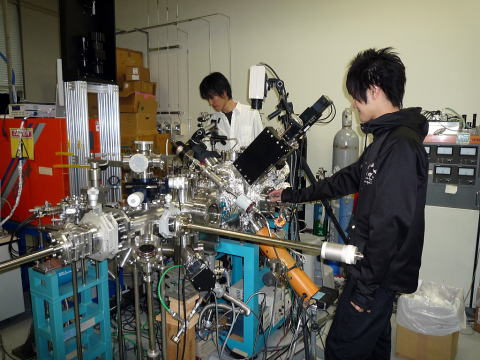
Pulsed Laser Deposition by Excimer Laser
.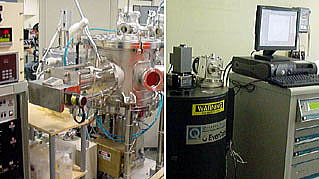
Updated manufacturing equipments for developing new electronic devices materials, e.g. superconductive devices, transparent conductive coating devices
.Keywords: Theory of magnetism and superconductivity, Quantum devices, Superfine
particle surface physics and crystal growth, Electronic device engineering,
Basic of oxide superconductivity, magnetism and dielectric, Theory and
experiment of thin film, Super lattice and super fine particles, Micro
manipulator for micro device, Application of fractals to optodevice, Semiconductor
surface physics, Fabrication of high temperature superconducting films,
Ultrasound technique for condensed matter, Flux pinning mechanism in superconductors,
Electromagnetic wave detector, Photo-rechargeable battery, Micro cluster
physics, Surface and interface physics
Electrical Power Engineering Course
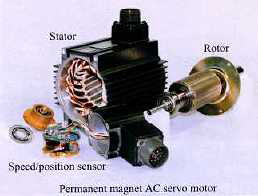
Permanent magnet AC servo motor
This motor is used in applications such as industrial robots, mechanical tools etc. The motor has permanent-magnets on the rotor and is driven by an inverter. Magnet shape and control methods of the motor are studied to improve efficiency and control performance of speed, torque and currents.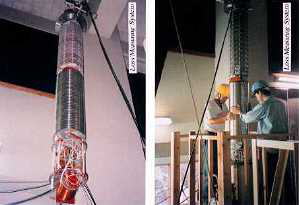
Transverse field loss measurement system for large superconducting conductors with DC transport current
This experimental apparatus enables us to evaluate the AC loss characteristic of large superconducting conductors with DC transport current under a transverse magnetic field. The evaluation of this kind is indispensable for us to put fusion device and superconducting magnetic energy storage system (SMES) to practical use.Keywords: Sensorless control of field-oriented AC drives, DSP-based AC drives, Analysis
of AC machines using FEM, Voltage-source inverter without DC Iink components,
Magnetic levitation systems, Super conducting magnetic energy storage system
for power system control, Large superconducting coil for fusion devices,
Influence of salt contamination on distribution lines, Optimal control
of multi variable digital control systems, Computer control systems, Power
electronics
Communication System Engineering Course
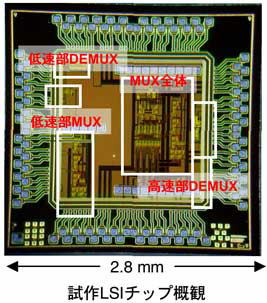
MUX/DEMUX-LSI TEG*** using a 0.18μm CMOS processing technology for a 10Gb/s optical communication repeater
.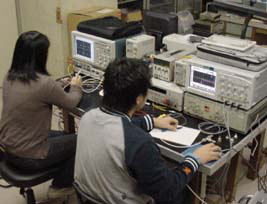
Characteristic evaluation of LSI
.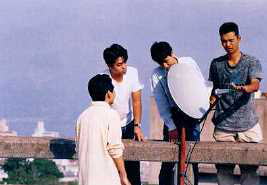
Experiments on receiving power measurements of Japanese Broadcasting Satellite (BS) waves
For these experiments, we use one beam transfer method and a flat metal(AI) reflector to feed BS beam into a BS parabolic antenna. (at a rooftop of a building of Electric and Electronics Engineering).Keywords: Radio wave propagation and spectrum utilization, Future system of broadcasting
satellite, Sound propagation and radiation in duct, Millimeter and sub
millimeter waves technology, Applied satellite communication system and
technology, Electromagnetic wave remote sensing technology, Analysis and
control of power systems, Nonlinear system theory, Biological cybernetics,
Design of measurement system to detect a weak signal, Analysis of delay
time in switching circuit with transistors, Biometrics sensor system, Self
organizing bioelectronic devices, Parallel computing, Fuzzy and neutral
system, New power devices
バナースペース
Electrical and Electronics Engineering Program,
Department of Advanced Engineering, Faculty of Engineering,
Department of Engineering, Graduate School of Science and Engineering,
Kagoshima University
1-21-40 Korimoto, Kagoshima, 890-0065 Japan.